

FamilyTreeDNA review: Unique genealogical collaboration, but an outdated interface - wilhelmplancionsing71
Editor program's note: This review was changed after publication to reflect new information regarding FamilyTreeDNA's privacy policy, which can be set up in the Privacy section down the stairs.
FamilyTreeDNA is the oldest DNA testing keep company—and it shows, for the wrong reasons. Its website and results appear outdated compared to newer, sleeker services like 23andMe and AncestryDNA.
That said, FamilyTreeDNA has some interesting features you won't discover elsewhere. IT takes a collaborative approach away letting you plowshare your genealogic and genetic info with a picture, where you can help uncover the shared lineage of families. It can also test up to three different parts of your DNA, depending on which versions of the test you pay for.
Virtually tests, like AncestryDNA and MyHeritage DNA, test just your autosomes. These are 22 of your 23 chromosomes containing DNA that you share with people happening both sides of your family. Autosomes are great for determination relations up to 10 generations back with ahead to to 95 percent accuracy; the accuracy declines as the coition grows more far-flung. Autosomes are also really good at estimating your ethnic inheritance.
 Dominik Tomaszewski/IDG
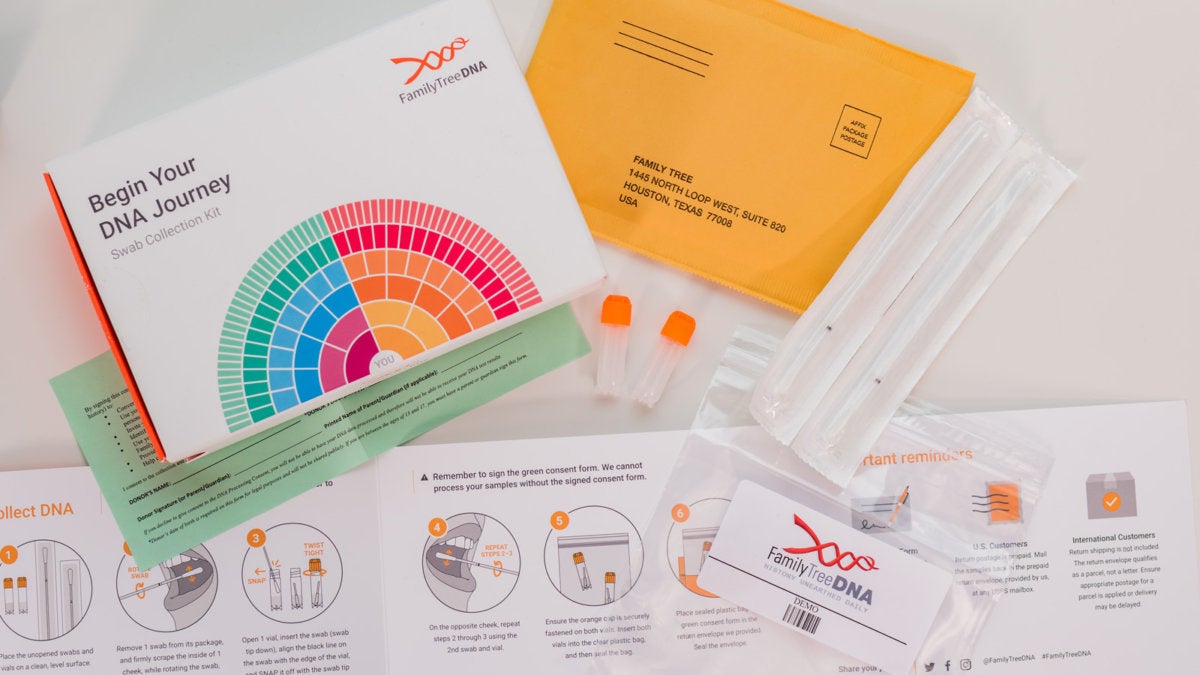
 Here's what's in FamilyTreeDNA DNA's kit.
Like 23andMe and Live DNA, FamilyTreeDNA DNA can also trial run your mtDNA and yDNA (if you'atomic number 75 male). mtDNA comes from your mother while yDNA comes from your father. These types of DNA can discover your antediluvian forebearers along either your mother's or generate's side, known as a haplogroup. With this information, the tryout can establish you the unlikely ancient migration patterns of your ancestors.
But FamilyTreeDNA disappoints with confusing pricing that requires you to pay extra to get more results about your DNA. The service charges separately to psychometric test your autosomes ($79), yDNA ($169), and mtDNA ($199). So information technology sets you backrest a whopping $447 to buzz off everything tested.
23andMe and Living DNA, then again, run all these three parts of your DNA for just $99. Though it should be noted that straight-grained though FamilyTreeDNA charges separately for each of its DNA tests, it examines more of your DNA's information to provide genealogic results compared to the more anthropological results from 23andMe and Living DNA. And FamilyTreeDNA isn't the only one to charge separately: Helix also nickels-and-dimes you with "upgrades" after you take your test.
To justify the costs, FamilyTreeDNA argues that its test more closely examines your DNA than its competitors. While other tests typically identify mutations to estimate an individual's ethnicity, FamilyTreeDNA compares up to 500 STR (short tandem repeat) markers, which are specific segments of DNA that people partake, and thousands of SNP (single-nucleotide polymorphisms), known as "snips" of DNA, that can distinguish a specific universe's common ascendant.
Because it provides a low-level analysis, FamilyTreeDNA is the only John Roy Major DNA test that can specifically identify whether a congenator is from your mother's or father's side. This feature alone makes FamilyTreeDNA DNA a test to consider.
For our review, we tried out the $79 Family Finder autosomal and $169 yDNA tests. Then countenance's bestir oneself.
Billet: This review is part of our best DNA screen kit roundup . Go there for details near competitory products you bet we tested them.
DNA collection
FamilyTreeDNA DNA's kit collects your DNA with cheek swabs that you send for testing. This is what's in the outfit:
- Two buttock swabs
- Two vials
- Specimen bag
- Return mailer
- Education brochure
- Registration form
The company just redesigned its publicity and provided PCWorld with a demo kit. Much equal MyHeritage Deoxyribonucleic acid, FamilyTreeDNA DNA's kit up now includes two oral cavity swabs that you intermission into vials of DNA conservation fluid. Before, information technology provided no preservation fluent for the swabs.
IT's unproblematic to take the test. Just assign to each one swab to one side of your mouth and rotate it for 45 seconds. Then, you can identify each swab in a ampule and snap it along the designated line, screwing the vial's cap on tightly afterward. Place the vials in the specimen old bag, seal of approval it in the return mailer, and send it off to the lab.
Dissimilar other tests, FamilyTreeDNA DNA doesn't require you to register your kit online. As an alternative, you're given login information in the electronic mail confirmation of your order. Make reliable the kit out's phone number matches the one you got in the email.
Speed
Since FamilyTreeDNA Desoxyribonucleic acid offers different types of tests, the time it takes to get results can vary. The basic Fellowship Finder test for your ethnicity and Deoxyribonucleic acid matches takes 4 to 6 weeks, while the other tests are 6 to 8 weeks. That makes FamilyTreeDNA DNA more or less like to MyHeritage DNA, which as wel takes 4 to 6 weeks for the equal rather results, while AncestryDNA and 23andMe occupy 6 to 8 weeks.
Results
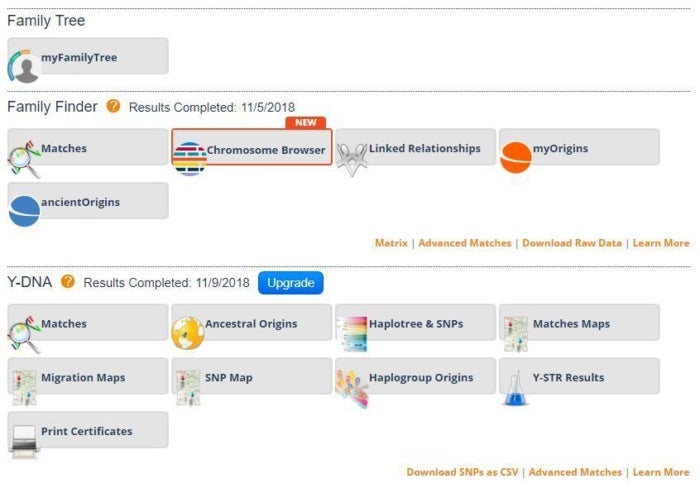
FamilyTreeDNA's online dashboard isn't streamlined and is sometimes disorienting. On that point are just so many a tabs under each test you purchased. Each tab opens up a page where you can acquire another tack of your DNA story. It doesn't offer any guidance almost where and how you should begin. I'd prefer a standing layout that guides you through your results like 23andMe's and Living DNA's approach.
 Dieter Holger/IDG
 It's hard to know where to start.
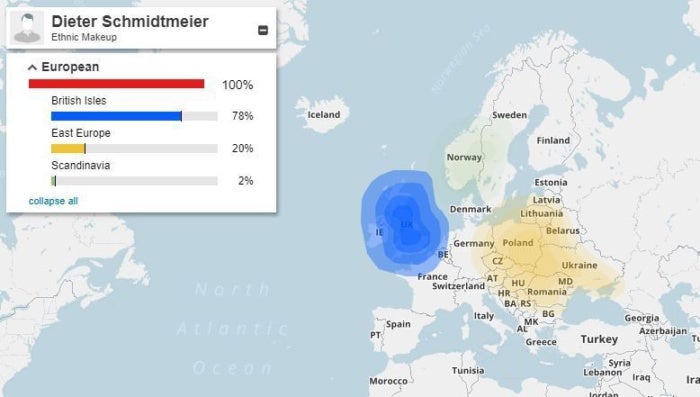
But my biggest problem with FamilyTreeDNA is that the ethnicity results, found low-level the myOrigins yellow journalism, were mode off. FamilyTreeDNA identified me as 78 percent British, 20 percent Eastern European, and 2 pct Scandinavian. Considering my father emigrated from Germany and both sides of his syndicate were natives with some Swedish lineage, these results were selfsame, very off. My mother's side has some British and (suspected) Northeastern European origin, but nowhere near decent to constitute 78 percentage of my ethnicity as British.
This is a pattern I've noticed in separate services such A MyHeritage DNA and Life DNA, which also identified me with mostly British ancestry. I suspect it's because Brits and Germans are genetically very similar as Europeans go. (The Angles and Saxons from nowadays's Germany invaded Britain in the fifth one C.) 23andMe and AncestryDNA didn't make the mistake of misidentifying my German ancestry, though.
Like all other filiation DNA test out in that respect, you can view your results in an interactive map under the myOrigins chit. This was a fairly three-needled and pretty unremarkable map. It also includes a My Ancestral History panel that updates with some historical context on all ethnicity.
 Dieter Holger/IDG
 FamilyTreeDNA DNA's myOrigins map is exemplary of what you find from other DNA tests.
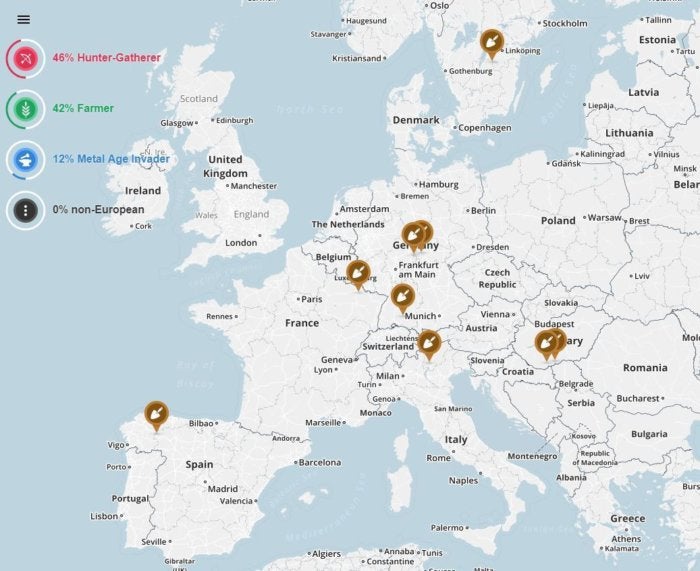
By far, the most interesting role is the ancientOrigins page. Here you will set about a percentage breakdown associating your autosomal DNA with past peoples based on archeologic dig sites. Information technology said I was descended 46 pct from hunter-gatherers, 42 percent farmers, and 12 percentage metal age invaders.
You pot and so clink connected this map and hit different icons to learn more about the dig sites your ancient ancestors are associated with. Each section also shows the migration routes these people followed into European Union.
 Dieter Holger/IDG
 The ancientOrigins page is a fascinating deal your Deoxyribonucleic acid fib other tests didn't offer, but it's lone available for hoi polloi of Continent descent.
Unfortunately, this feature is simply available to citizenry of European descent. FamilyTreeDNA DNA notes that most of the public is non-European, saying they "currently do non have enough scientific information" to group them in the same way. This kind of group bias is widespread crossways the DNA tests, merely companies are functioning to fix it.
FamilyTreeDNA DNA says, "As more than significant Deoxyribonucleic acid evidence is found in other regions of the world, we will work to continue to get in touch the old with the present tense in our effort to further our understanding of the interconnectedness between us all."
Now let's move to FamilyTreeDNA DNA's motherline and fatherline tests. I didn't take the Maternal Ancestry tryout on my mtDNA, but I did take the paternal test for my yDNA. And the results were underwhelming.
At the Y-Desoxyribonucleic acid part of the dashboard, you find eight different tabs. Most of them are just tables with percentages or numbers racket for how much your DNA compared to samples it tested against. Beautiful boring and not interactive at altogether.
Then in that location are the maps. The SNP Map page shows the locations of samples your haplogroup matched with. Sounds interesting, decent? Unfortunately, it's an incredibly slow down, confusing joyride in desperate need of an kick upstairs. You have to select your haplogroup from a drop-down card of thousands of options, instead of the map just mechanically loading up your corresponding information. It's rattling unwieldy and frustrating.
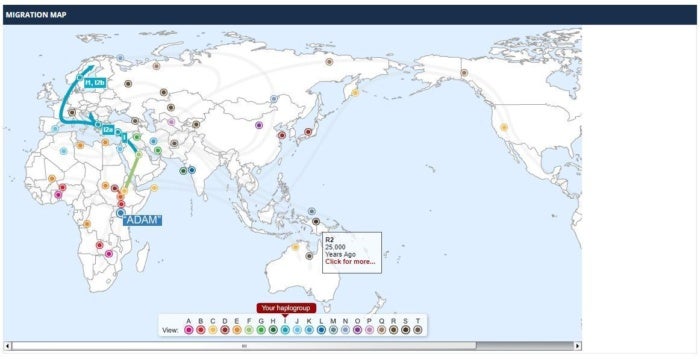
The most disturbing visualization was the Migration Maps because it required Flash Player to run. (I mean, who uses Flash these years?) It displayed some interactive information on migration patterns associated with certain haplogroups, but it made me feel nostalgic about the internet in a bad way. It besides didn't bother to mark what haplogroups you were associated with. So it was an information deck that didn't make very much sense.
 Dieter Holger/IDG
 The dreadful Flash-supported Migration Maps.
You can as wel explore matches with early people World Health Organization share some of your agnatic yDNA, and apparently, I sole had one match in the entire system of rules. FamilyTreeDNA Deoxyribonucleic acid is the simply test PCWorld reviewed that matches you specifically past paternal or parental line, so we can't compare its results here to different services.
Gross, the uncastrated Y-DNA section was unimpressive and doesn't seem meriting the $169 FamilyTreeDNA Deoxyribonucleic acid charges. Only if you are trying to find relatives on your father's or mother's side,you might feel otherwise.
FamilyTreeDNA Desoxyribonucleic acid's almost redeeming quality is the collaborative path you can contribute to genealogical projects. E.g., my surname of "Schmidtmeier" is unitary of the last name calling involved in a project trace lineages originating from the German Principality of Lippe. This was interesting since I've never heard about any ties to this obscure region of Germany.
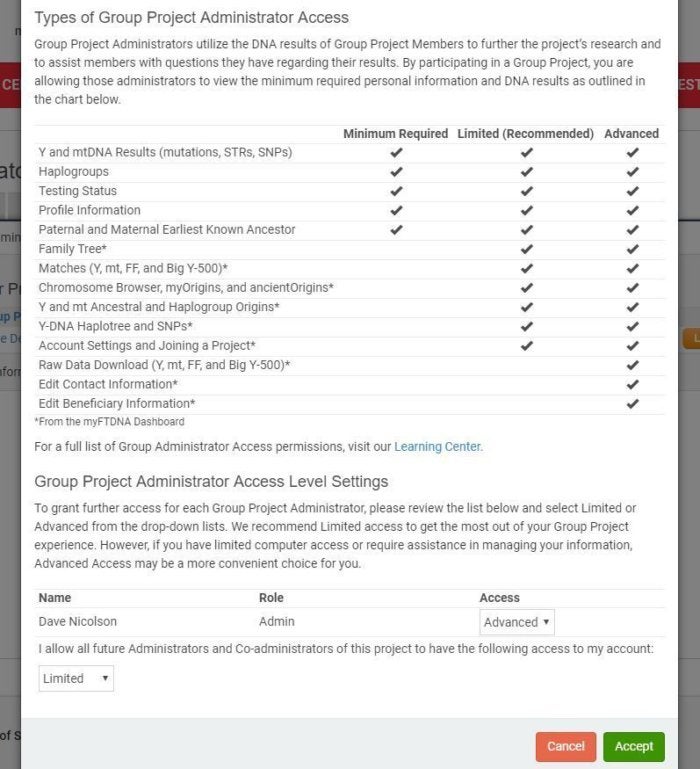
You can join these projects and choose how much information you'd like to make available. In that location is a minimum setting, a recommended i, and an advanced peerless. The minimum gives data so much As your haplogroup and matches, while advanced lets the project administrator download your raw DNA information.
 Dieter Holger/IDG
 The levels of information you can furnish to a group project.
After you join, your genetic information is successful available to the offer who is managing the program. You'll incur updates aside email A the envision progresses and the decision maker Crataegus laevigata range extinct to you.
Other projects identify specific variants in your Desoxyribonucleic acid that tie you in. All of them have the intent of tracing the lineage of thick swaths of people who share just about DNA. This feature gives FamilyTreeDNA DNA lasting respect. Non to mention, you force out well get wrapped for hours in the many projects out there. Mayhap you'll equal make up one's mind to start your own visualise?
DNA matchmaking
Like hardly about every other DNA screen kit, FamilyTreeDNA DNA has a DNA matchmaking service that pairs you with people who partake your Deoxyribonucleic acid. This can avail you find relatives you never knew existed (if they have also expropriated the test), or you ass just gaze in wonder at the thousands of random people whose DNA you share.
You can send on a subject matter to someone you matched with, see the surnames all person has listed, and bestow some personal notes about them if you'd like. It tells you the relationship you have with that person, such as if they are your indorsement cousin Beaver State sibling, and the number of shared centimorgans in your DNA that you share with that person.
Goodish news: My sis took FamilyTreeDNA DNA's test, and I'm happy to report IT correctly identified us As siblings.
Privateness
To begin with, FamilyTreeDNA stood out from the pack with its promise to never sell Oregon share your genetic data. But an investigative report by Buzzfeed News found that FamilyTreeDNA was as a matter of fact practical with the FBI, and giving the agency get at to user information that matched DNA samples found at law-breaking scenes.
It is come-at-able, however, to choose out of law enforcement twinned, which is delineated in the party's Secrecy Instruction. You can make this and former selections of how your DNA data is mutual under Account Settings, where you'll find the Privacy &adenosine monophosphate; Sharing tab. For example, you can pick out what information you want available to people you match with, including things like your ethnic estimate.
If you wish to delete your genetic data or get your try out burnt, you'll need to contact customer divine service. Unfortunately, there's no path to easily request this in the vena portae, unlike with AncestryDNA.
Value
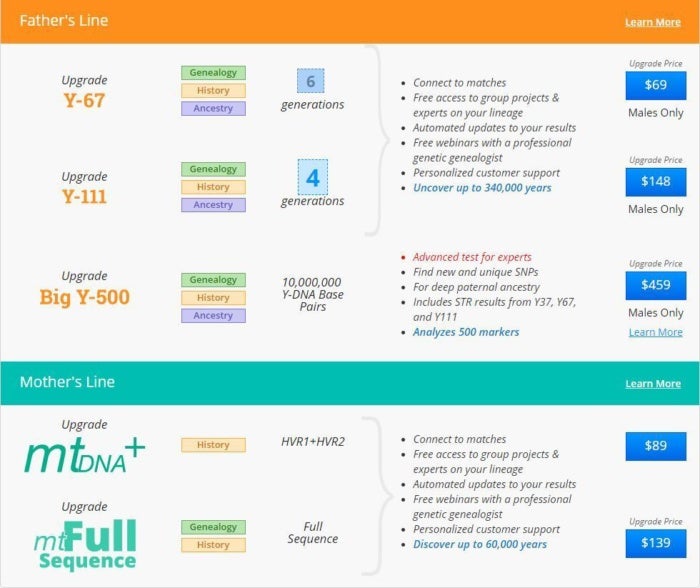
FamilyTreeDNA's pricing system of rules is our least favorite thing just about the help. There are three basic tests: Family Finder for $79, Parental Derivation for $169, and Maternal Ancestry for $199.
The thing is, you can pay even more to upgrade your results further. These upgrades add genealogical features to pair your DNA with records on your house and build out a R. Buckminster Fuller picture. (We didn't review FamilyTreeDNA Desoxyribonucleic acid's genealogical service so we can't tell you much about it.)
 Dieter Holger/IDG
 FamilyTreeDNA Deoxyribonucleic acid's confusing pricing tiers.
For case, upgrades to the yDNA test buns set you back as little as $69 to as much as $459 for the "advanced test for experts." FamilyTreeDNA DNA argues that its quiz is more than low-layer than competitors like 23andMe, which just feel at mutations to analyze your mtDNA or yDNA. Equally much, FamilyTreeDNA DNA can match you with relatives specifically from your mother's or father's side. So that is a unique offering you won't find from competitors, possibly warranting the high price tag.
If you don't care about learning about the ancient ancestors on your mother's operating theater father's side, you can just buy in FamilyTreeDNA DNA's Sept Viewfinder service for $79. Information technology's essentially the same serving you stupefy from AncestryDNA, breakage down your ethnicity on a map and twin you with relatives it identifies in the system. It's also $20 cheaper than AncestryDNA but $10 more MyHeritage DNA (our "best bang for your long horse" mental testing).
Editor's note: Because online services are often repetitious, gaining new features and performance improvements complete time, this review is field to vary in order to accurately reflect the present-day state of the service. Any changes to text or our final review verdict will be noted at the top of this clause.

Source: https://www.pcworld.com/article/403026/familytreedna-review.html
Posted by: wilhelmplancionsing71.blogspot.com
0 Response to "FamilyTreeDNA review: Unique genealogical collaboration, but an outdated interface - wilhelmplancionsing71"
Post a Comment